Showing posts with label guest blog. Show all posts

Sunday, September 24, 2017

DAVE ALBER GUEST POST: What is the Ecological Vision of Myth? #September #blog #mythology #ecology #SundayMorning

Heart Of Myth Kindle Edition Amazon


What is the Ecological Vision of Myth?

Production, development, growth, and consumption are all on the rise. We hate to imagine the economy behaving otherwise. And we pretend that this stage in the economic cycle is the norm. Why do we pretend?     -Dave Alber,  "The Sustainable Vision of Endangered Societies"


Hello Blogosphere!

I’m Dave Alber, the guest blogger for September on Stephanie Pope’s mythopoetry.com blog.
In previous blogs… I introduced the core grammar of myth and described the alchemical nature of myth… now lets consider the moral and philosophical implications of participating in a unified world recognized within the awareness-heart, empathy as a synthetic process of awareness connecting us all together.

How can we treat apparent “others” within a worldview that recognizes

1.) everything as divine and
2.) everything as an expression of a unified field of being.

It’s a quandary pondered in the essay “Guest Rituals”.
In The Heart of Myth: Wisdom Stories from Endangered People, we see that across the globe, the polytheistic world has resolved the problem presented by the mystical revelation along ecological lines, because there are sustainable vision underlying the myths of indigenous people across many continents.

The 2nd day of Tihar festival is Kukur Tihar, a day when
dogs are celebrated as a manifestation of the divine
.

[What
follows is from The Heart of Myth.]

The Sustainable Vision
              of Endangered Societies


No economist, industrialist, or politician would ever suggest that the earth’s resources might be consumed indefinitely at their present rate. Yet, looking at the media, the compulsion to consume appears paramount, while the Classical virtue of temperance is nowhere to be seen. Production, development, growth, and consumption are all on the rise. We hate to imagine the economy behaving otherwise. And we pretend that this stage in the economic cycle is the norm. Why do we pretend? Perhaps at some deep level, Western Culture does not believe in limits. Perhaps that is its key virtue, inspiring discoverers and adventurers to push the envelope in all directions. That is the song we like to hear, is it not? It is the theme of the DVD we rent. All limits are surpassed; all conventions are broken; the young lovers escape the traditional values that confine them. Yet, limits are also what define and give context to every freedom.

Nevertheless, on realizing the dangers of the global civilization’s unsustainable economic vision, many people have looked to other models—other visions offering a more workable human future. Surprisingly, sustainable visions of human culture are in abundance. In seeking them, we find ourselves immediately upon the “red road” of plentitude. Many small societies have maintained sustainable modes of living for thousands of years. Historically, their vision has been the norm—ours the exception. As Jerry Mander states in Paradigm Wars: Indigenous People’s Resistance to Globalization:

. . . it is no small irony that the very reason that native peoples have become such prime targets for global corporations and their intrinsic drives is exactly because most indigenous peoples have been so very successful over millennia at maintaining cultures, economies, worldviews and practices that are not built upon some ideal of economic growth or short-term profit-
seeking.[1]

Therefore, there is not only a moral imperative to protect the cultures threatened by economic shortsightedness, but also an imperative of ultimate practicality. “In more ways than one, indigenous issues are the frontier issues of our time.” Mander explains:

They deal with geographic frontier struggles where the larger, destructive globalization process attempts to suck up the last living domains on the planet—its life forms, its basic resources, its peoples—in the empty cause of short-term wealth accumulation. And it is also a frontier struggle in conceptual terms: What are the values that can sustain us for the future? What are the worldviews that can keep the earth alive? How are we to live on behalf of coming generations of human beings and the larger community of beings and creatures?[2]

For global civilization to “progress” on its present course, people must be exploited like “resources.” By contrast, the core mode of perception of polytheistic communities—the knowing of the heart—is a vigorous safeguard against such a systemic cultural imbalance. The knowing of the heart is congruent with the great traditions of Western Humanism and is the safest way for individuals within the system-driven civilization to sustain the fragile candle of their
fullest humanity.


[1] Mander, Jerry and Victoria Tauli-Corpuz. Paradigm Wars: Indigenous Peoples’ Resistance to Globalization. San Francisco: Sierra Club Books, 2006. p. 4.
[2] Ibid. p. 10.

The Organization of The Heart of Myth

Following some of the logic of Greenwood Press’s The Endangered Peoples of the World Series, the polytheistic cultures in The Heart of Myth are organized into six sections which align with a geographic region: North America, the Arctic, Central and South America, Africa, Asia, and Oceania. The Heart of Myth describes several communities from within each region and relates their mythological narratives.

Choosing the Cultures in The Heart of Myth


In choosing the cultures of this book, diversity was of key interest. To use Africa as an example, oftentimes when discussing African mythology, the Yoruba mythology that made its way west to the American continents and Caribbean islands due to the slave trade is discussed as representing the varied mythologies of this vast continent. However, African culture and mythology is much more diverse. Speaking collectively of African mythology makes about as much sense as speaking collectively of Asian mythology: as though the mythologies of India’s Vedas, Puranas, epics, regional and folk traditions; Tibet’s Bonpo and Buddhism; Nepal’s syncretic spirituality; China’s Taoism; Japan’s Shinto; and South East Asia’s diverse mixture of indigenous traditions and most of the traditions mentioned above would so conveniently fit into a single category. The importance of highlighting this diversity is precisely because those communities that are the least recognized are those most endangered by their apparent invisibility.

In doing the research for this book, one of the delights of choosing this approach was in discovering, again and again, that the seeming invisibility of a culture in no way demonstrates a reduction of the beauty or sophistication of its mythology, life ways, or spiritual beliefs. The Karanga mythology of Zimbabwe, for example, reveals a biological sophistication comparable to Indian Ayurveda or China’s Taoist medicine. It is due precisely to its sophistication that Zimbabwe’s traditional healers are fighting against a Swiss University and a U.S. corporation, both of whom want to patent Zimbabwe’s snake bean tree.

The three types of diversity emphasized in the selection of narratives are geographic diversity, cultural diversity, and diversity of endangerment.
·         Geographic Diversity. All geographic regions in this book are represented by different geographic terrain and the cultures that have developed out of them.

·         Cultural Diversity. Africa, for example, is home to hunting and gathering, farming, fishing, and herding cultures as well as cultures whose life ways represent borrowed elements from overseas and mixtures of all of the above, often in increasingly modern urban areas. An emphasis is placed on the more unrepresented at-risk communities.

·         Diversity of endangerment. The world’s indigenous cultures are defending themselves from many corporations, universities, and political groups. The problems they face are many and varied. It is the intention of this book to present a clear picture of the diverse range of difficulties facing these traditional people.

Service To Endangered Polytheistic Peoples


Like the transformational alchemy described within so many of these myths, it is generally understood in the Orient that to know is to be transformed. According to this philosophy, to know something means to behave fundamentally different from before the acquisition of the new knowledge. Truly then, we have learned nothing at all about the often overlooked abuses of global civilization and the communities who are threatened by it, unless we, as individuals and as a greater community:

·         Alter our relationship to the corporations, nations, and institutions that are endangering or exterminating the living polytheistic communities, and

·         Extend our relationships outward—in the sympathetic recognition of the heart—to these endangered communities in action, financial support, or humanitarian service, and

·         Pressure the current administrators of the system of economic globalization to support a sustainable vision of the human future that does not depend on the exploitation or systematic extermination of others.

The Heart of Myth ends with a list of resources that offer service to endangered societies. In this collection of myths, all stories—as projections of the sympathetic heart—express a devotional worldview. Let this devotional vision of the absolute divinity of the “other” inspire us to new knowledge expressed in our individual and collective imagination, compassion, and action. May our hearts be awakened sympathetically within all our relationships, and may our behavior be consistent to the eternal values of myth.

In The Next Blog 


We explore how the grammar of the mystical function of myth and the ecological vision of myth relate to the myths of North America. 


ABOUT THE AUTHOR


Dave Alber is the author of To the Dawn, Myth & Medium, and Alien Sex in Silicon Valley. His book The Heart of Myth is a global anthology of living myth that unpacks the grammar of world mythology. His website is DaveAlber.com and his English learning products are at EasyAmericanAccent.com


DAVE ALBER  September Guest Blogs


Tuesday, September 19, 2017

DAVE ALBER GUEST POST: What Is The Core Grammar of Mythology? #mythology #TuesdayThoughts #September #blog

The Heart of Myth: Wisdom Stories from Endangered People


WHAT IS THE CORE GRAMMAR OF MYTHOLOGY?

Hello Blogosphere!

I’m Dave Alber, the guest blogger for September on Stephanie Pope’s Mythopoetics In Culture Blog.
I gave a short bio in the last blog: “What is myth?” 

In that last blog, I wrote about awareness states being primary to the grammar of myth. If myth, for example, is a sphere, then an awareness state is at the gravitational core of that sphere. This is the premise of my book The Heart of Myth: Wisdom Stories from Endangered People, which is an anthology of living myth (meaning the myths of living polytheistic communities.) Unpacked section at a time… The Heart of Myth is an attempt to share with a wider audience the grammar of myth as a system for the transmission of profound states of awareness.

If Campbell’s The Hero with a Thousand Faces was Campbell’s attempt to teach people how to read a myth, then The Heart of Myth is my attempt to unpack the grammar of the mystical function of myth.

To this end, in this blog… we will take our first steps in our discovery — inward, ever inward — toward that foundational state of awareness from which myth emerges. 

What follows is from my book pictured above, The Heart Of Myth.

Introduction

Global Civilization and the Wisdom of Polytheistic Peoples


Since I was a boy, I spent many hours with my nose in a book while my imagination flew to other continents entirely. I was often entertained, and am still daily entertained, by the most direct manifestations of wonder I know—mythological tales from around the world! To me, myths always present an enigmatic, semi-recognizable, yet palpable beauty that defies logical explanation. Like riddles, Zen koans, poems, or pieces of music that bring unexpected tears or elation, myths communicate experiences that challenge the rational processes of the mind. Whether the story is a Crow myth of world creation or an Inuit tale of shamanic flight; a Maori story of the origin of knowledge or an Ainu tale of supernatural realms, the mythologies of the world present one vast and interconnected tapestry of timeless beauty and timely wisdom. Simultaneously, these stories refresh us with their eternal human values and shock us awake to our responsibility in both our living continuity and the present historical moment.

Perhaps because my enjoyment of mythology has too often been both bookish and escapist, it occurred to me with some shock that economic and political forces now endanger most of the world’s living polytheistic communities. Despite the importance of mythology for artists, psychologists, historians, anthropologists, folklorists, and other professionals in the modern world (not to mention those people to whom the stories are still fluid emanations from spiritual realms), the contemporary inheritors of these primary stories find themselves threatened by voracious economic and social forces that know no bounds and, at present, no human restraint. As Barbara Rose Johnston states in the forward to the Endangered Peoples of the World series:

Human action and a history of social inequity leave some people more vulnerable than others. This vulnerability results in ethnocide (loss of a way of life), ecocide (destruction of the environment), and genocide (death of an entire group of people).[1]

The polytheistic communities visited in these pages are so imperiled. In popular usage, the word myth denotes an untruth—a lie. And although there is some truth to that, the truth of the lie exists in our own forgetfulness to myth as one of the foundational expressions of both human culture and spirituality. In Homeric Greece, the term mythos was understood as the mode of speech of the muses and poetic bards. However, it was also appreciated as “an unvarnished truth . . . a blunt and aggressive act of candor, uttered by powerful males in the heat of battle or agonistic assembly.”[2] In Ancient Greece, then, mythos was a mode of expression that was both radically complex and profoundly straightforward. Mythos was understood as expressing a direct form of knowledge. This direct form of knowledge is recognized in every corner of the globe as the heart’s way of knowing. “What does your heart tell you?” we still ask our friends and loved ones, when facing important decisions. We trust the heart implicitly with the understanding that it is incapable of lying. What the heart knows, it knows through a direct sympathetic relationship that defies the logic of the materialistic worldview.


The Heart’s Way of Knowing

Sympathetic knowledge is to know another’s experience directly by becoming the “other.” It is the source of empathy. It is knowledge of the heart. This knowledge of the heart is the principle way of knowing in polytheistic culture. To know an “other” is to become the other—to loose the false perception of separateness with the other—and to feel through the other’s world directly. In polytheistic cultures when people know the gods, they know them directly—sympathetically—through their hearts. It is the nature of the heart to know directly.
In The Inner Reaches of Outer Space, Joseph Campbell considers our historical moment in the late 20th century—the global crisis of the world’s people being unified by a technological economy. He ponders the question, “What is the new mythology to be, the mythology of this unified earth as of one harmonious being?”
He writes: 
 

One cannot predict the next mythology any more than one can predict tonight’s dream; for a mythology is not an ideology. It is not something projected from the brain, but something experienced from the heart, from recognitions of identities behind or within the appearances of nature, perceiving with love a “thou” where there would have been otherwise only an “it.”[3]

Monday, July 10, 2017

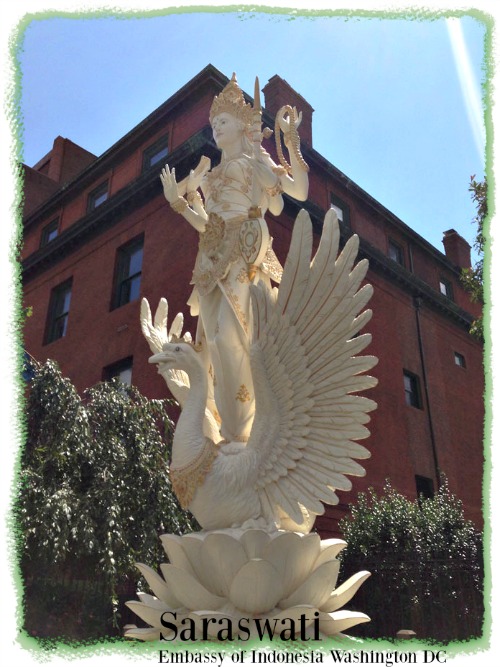
SARASVATI: The Flowing One Deanna McKinstry-Edwards #guestpost #July #MondayMotivation #Sarasvati #Saraswati #Saraswathi


SARASVATI: The Flowing One
by Deanna McKinstry-Edwards

In the bright world, where the light of the world opens, In the bright world, at the furthest border of The Word, Sarasvati poured out her rivering voices. Down, down, deeply down, the syllables flowed from the something that shines at the center of the world.            


            She came to me when the waters of my life were frozen.  I think I’d heard Her name many years ago, but nothing took hold, and perhaps I even heard Her call mine.  Some voices sound like the wind. Some like rain.  They rustle, they loosen, but its not yet their time to linger, so they pass through you, time and again, rustling, loosening your mind until you can hear and heed them in the language they speak. 

I had some exposure in my early days to stories of Goddesses, but I had not heard there was a Goddess who moved the world by a word, a syllable, a voice.  Fortunately, weather bristles in one’s psyche when the time is right for all manner of voices and words to be heard, to upend, to reconnect, to sing songs and retell stories long forgotten.  These stories work like magnets tugging at the personal story of each person’s life, wresting it from impoverished moorings too isolated from the epic and collective human story, and too fixed with nailed down notions to support the beneficent chaos which initiates birth and creativity.

            We were destined to meet, Sarasvati and I, since I have been, an actress, a singer, a writer, a devotee of breath churned into expression through melody and words.  For this is Her realm, the domain of sound, singing, eloquent speech, and intuitive wisdom. Originally a river goddess in the ancient Vedic texts, Sarasvati is the archetypal figure who embodies wisdom through the flowing motion of sound and running water.  Hers is the archetypal energy that compels us to break loose from inhibiting forces and stuck places, especially those rutted in our minds.  She compels each of us to loosen our notions and animate dialogues with ourselves, others, and all life, continually moving our minds like leaves riding a river.  It is not closure Sarasvati seeks, but open-ended conversation. 

            To meet Sarasvati, The Hindu Goddess of Speech, Sound, Music and Wisdom, is to meet the holy rivers veined through the inner and outer landscapes of our lives. “Sarasvati is the Word, and the Word is the way of The Gods.” (Calasso 239) writes Roberto Calasso in his lush and erotic book, Ka;  Stories of the Mind and Gods of India.  “The Word, and these waters, are the one help we have.  We shall follow the Word, so as to be able to leave it behind.” (Calasso 239)  Beyond the Word, it was written in the Vedas, was the center of the world.  A place  known as “Only something that shines.” (Calasso 239)

It was not the fate of all Hindu goddesses to remain important in later Hinduism.  But Sarasvati exemplified her own attributes of change and transcendence, by representing a  wisdom which permeates all life, that being to remain open to and flowing with life’s ever-changing nature.  Something primordial defines Sarasvati which extends beyond cultural associations to cosmic tendencies and attributes, and this feature of her archetypal zest is no doubt key to her continued survival and importance in Hindu culture even today.

David R. Kinsley,  author of Hindu Goddesses, describes Sarasvati’s earliest appearance as a river.  She is

“no ordinary river.  Early Vedic references make it clear that the Sarasvati River originates in heaven and flows down to earth.  Physical contact with her earthly manifestation, however, connects one with the awesome, heavenly, transcendent dimension of the goddess and of reality in general.” (Kinsley 57)


Even before Sarasvati The River and The Goddess flowed down from the celestial heavens, another Goddess, her ancestral progenitor, quickened and fertilized the visible and invisible aspects of the world through sound.  Her name was Vac.   The Goddess of voice.  Of word.  “Queen of a thousand syllables…” (Calasso 238), “Vac was a power at the world’s beginning.” (Calasso 238)  Wherever life grew parched,  and living things lost their luster, it was Vac who moistened and brighten them at their source.  With sound. Sarasvati emerged from the mythical husks of Vac, and though initially and consistently identified with her, over time Sarasvati came to represent characteristics other than those originally ascribed to Vac.

Although the distinction of sound and speech as primordial factors in the creation of the universe is a post-Rg-vedic concept, nevertheless sound, and speech especially when ritualized, are regarded in the Rg-veda as an integral aspect of cosmic creation and order.  Vac’s attributes exemplified the theory prevalent in many mythologies that the origin of the created universe occurred through sound.  In Hinduism, Vac besides being a primordial creative force, is also honored as

 “the presence that inspires the rsis.  She is truth, and she inspires truth by sustaining Soma, the personification of the exhilarating drink of vision and immortality.  She is the mysterious presence that enables one to hear, see, grasp, and then express in words the true nature of things.” (Kinsley 12)


Bear in mind, Vac was more than an abstract concept.  Her essential nature was that of an omnipresent, nourishing goddess, forceful as a lioness, decked in golden raiment, capable of fostering both fiercely and tenderly, organic growth as a result of providing the blessings of language and vision.  She is equated no less with the creation of Hinduism’s three Vedas, the earth (Rg-veda), the air, (Yajur-veda), and the sky (Sama-veda).  She is a Goddess at the very source of life, and Hinduism’s holy writ.  Gradually Vac’s vivid personification was assumed by and metamorphosed into Sarasvati.  Centuries later, additional qualities became attributed to Sarasvati which took on a primacy in the shaping of Hindu culture.

To understand Sarasvati’s transitions from earlier associations with Vac into her own Goddessdom, and from her earliest identification with the cleansing purity and fertility of the Sarasvati River, and rivers in general, one needs to consider the historical and cultural transitions occurring when nomadic life in India metamorphosed into agricultural, village societies.  Rivers were the life blood to these societies.  Understanding the nature of rivers was mandatory to survival.  Sarasvati’s river heritage affirmed a tendency in classical Hinduism to perceive the landscape itself as something sacred.  Rivers were considered symbolic places for planting, for healing, where one could cleanse one’s body and spirit.  Furthermore, not only were rivers places into which one could immerse one’s bodily self, metaphorically they assumed imagery indigenous to all three Indian religions, Hinduism, Jainism, and Buddhism—that being the fording of a body of water, be it river or stream for spiritual attainments.  By crossing over to the other side of a river, one drowned the deadening beliefs of the old self to be born afresh, to be liberated from the past, towards a new, more enlightened way of being in the world.

It is not known exactly, how The Goddess Sarasvati became less connected with her original river goddess status, and more associated with another Goddess, Vagdevi, the Goddess of Speech.  Kinsley speculates that,

“Perhaps the centrality of sacred speech in Vedic cult and the importance of Vedic rituals being performed on the banks of the Sarasvati River led to the identification of the two goddesses.  In any case, Sarasvati increasingly becomes a goddess associated with speech, learning, culture, and wisdom; most post-Vedic references to her do not even hint that at one time she was identified with a river.” (Kinsley 57)


I would suggest also that the transition Sarasvati traveled from ancient river status into the goddess of speech expresses an archetypal connection between a river’s ability to carry earthly sediments, and the voice’s ability to carry emotive sentiments. Intrinsically linked, voices and rivers move and shape inner and outer topographies.  Soul as soil, soil as soul.

Insofar as Sarasvati would eventually become a goddess equated with the refinements Hinduism attaches to culture and transcendence of the natural world, Sarasvati  could be said to have come full circle.  That is, as a Goddess of  learning and wisdom, such as it is attained through language, She has, in a sense,  returned to her celestial fount in the heavens, a domain above human travail.  But even though Sarasvati in present times is often represented as transcendent, purified knowledge and wisdom, riding a heavenly swan above the toil and turbulence of the natural world, she can also be Sarasvati seated on a lotus, rooted in the muck of earthly bogs.

Although rooted in the mud (like man rooted in the physical world), the lotus perfects itself in a blossom that has transcended the mud.  Sarasvati inspires people to live in such a way that they may transcend their physical limitations through the ongoing creation of culture. (Kinsley 62)


Sarasvati upholds a theme in Hinduism that affirms that human destiny is inextricably tied to notions of the refinement of nature.  Nature without these cultural refinements is not considered suitable for the fullest unfolding of a human being in Hindu thought.  These sentiments regarding the refinement of nature as essential to a human’s fullest potential possess a Western bias as well, and in so doing tend to emphasis and esteem certain human attributes at the expense of others.  With the more recent emphasis on purity and transcendence of the physical world, India’s present day Sarasvati appears more disembodied than her earlier incarnations.  But for all Her purified, sattvic nature, Sarasvati remains a Goddess of music as well as speech.  Music is untethered speech.  At her core, Sarasvati contains the fertile, rushing sap of Her beginnings; a juice squeezed from the Vedic philosophy of the primacy of syllables.  Jonathan Levi, in his review of Literature and The Gods, by Roberto Calasso,  in The Los Angeles Times, April 22, 2001, quoting from Calasso, writes, “One squeezes juice, from anything, but not from the syllable:  Because the syllable is itself the juice of everything…And from the syllable all else flows.”

Sarasvati is a particularly juicy goddess for modern times, especially perhaps, for modern day women.  She is not a goddess of motherhood, or the fertility of the fields, except metaphorically.  What She gives birth to are creations other than human progeny.  Hers is not a domestic presence in the traditional sense of keeping house, but of housekeeping by creating eloquence, art, wisdom through artistic discovery, poetry and music. With words She tills the fields of  human longing and  imagination.  She is the running dialogue at the center of  human affairs, spinning the stories within which we nourish our lives.  “The world is made up of stories, not atoms”, wrote poet Muriel Rukeyser.  The sounding harp of the Universe is plucked by Sarasvati, and key to understanding her wisdom, is hearing and releasing the sounds She makes, allowing them their ever flowing, ever-changing-ness.

In my own life, Sarasvati’s presence has been especially potent and integral these past few years.  A story about Her swayed my decision as to where and how I should continue my education following a return to school to complete a bachelor’s degree begun over thirty years ago.  Drawn to Pacifica Graduate Institute, torn between a degree in Psychology, which I perceived as possessing definite financial largesse somewhere up ahead, and The Mythological Program which seemed possessed with as sure-footed a financial future as the acting profession, I cast my net for a sign, an omen.  I got a story.

Once upon a time in a faraway land, a man went into the forest to see his spiritual master.  “I want to have unlimited wealth, and with that wealth, I want to help and heal the world.  Will you tell me how to create this affluence?

The spiritual master replied.  “There are two goddesses which reside in the heart of every human being.  Everybody loves these two goddesses, but there’s a secret you need to know, and I will tell you what it is.”

Although you love both of these goddesses, you must pay more attention to one of them.  She is the Goddess of Knowledge, of speech, music and sound, and her name is Sarasvati.  Pursue her, love her and give her your attention.  For when you pay more attention to Sarasvati, the other goddess, Lahksmi, the Goddess of Wealth, will become extremely jealous and pay more attention to you.  The more you seek Sarasvati, the more the Goddess of Wealth will seek you.  And she will follow you wherever you go, and never leave you.

In that mysterious way our Psyche senses even seizes what it really wants…and, in the gap between that psychic sensing and fearful admonitions of the ego, responses glimmer.  Of course, I already knew which program it was I wanted.  The Myth Program.  The one with the knowledge that really called to me.  It was just a question of how much faith and derring-do I still retained. It was just a question of letting a story reconnect me back to the source of something shining.

Certainly a most shining manifestation of Sarasvati in Buddhism was a woman who became the first Tibetan to attain complete enlightenment.  Her name was Yeshe Tsogyal, and her life story is written about in a book, Lady of the Lotus Born.  She is often referred to as The Great Bliss Queen.

For Padmasambhava, the guru who brought Buddha’s teaching from India to Tibet, to propagate his teaching of the Secret Mantra, he felt the time had come for an incarnation of Sarasvati to appear.  Yeshe, whose birth reverberated a Sanskrit mantra through the air so powerfully that a nearby lake increased to almost twice its size, was the wife of Emperor King, Tri-song-dat-tsen of Tibet.  It was Tri-song who invited Padmashambhava to Tibet to spread the new tradition of Buddhism.  With his consent, Yeshe became Padmasambhava’s consort and foremost disciple. She was the embodiment of the Sarasvati he was looking for.

Yeshe and Padmasambhava through sexual union, mantras and chanting dissolved artificial boundaries between the mind and the body.  Rather than forsaking and attempting to transcend the body, the Tantric wisdom that Padmasambhava advocated engaged both body and mind for enlightenment.  Creating a bridge of sound between mind and body composed of sounds and sacred syllables facilitates an enlightening, informing dialogue between them.  Keeping this river of sound flowing and being aware of its ever-changing, interdependent behavior is the heart of Buddhist wisdom. Buddhism’s most reknown Sarasvati, Yeshe Tsogyal, learned how to make her body sing, and became both the singer of her life’s song, and the song itself. 

 Sarasvati, such as She manifested in the bodhisattva archetype of Yeshe Tsogyal, presents an embodied Goddess who has married within herself the heavier, darker emotional sounds of soul as they move through the human body, and the flute-like soaring sounds of spirit, such as they leap from the human mind. This Sarasvati appeals to me immensely, for no parts of Her appear to be in exile.

Today, with so much talk about creating a sense of community in our lives and world, saturated as they are with feelings of alienation, I feel Sarasvati’s presence holds a promise. As the Goddess of speech and music, She carries the virtues of connection and communication. Robert Sardello writes in his book, Facing the World With Soul,. “When community does show forth among people it shows in the word, the living, creative, unexpected, heartfelt, spontaneous, thoughtful, reflective speaking through which the soul of the world finds voice.” (Sardello 181).  This is Sarasvati’s Queendom, the shining place where words wait to be born in the mouths of living things. Voice is how the soul speaks

In speaking the breath connects us to each other.  When we bank and shape this breath with the consonants and vowels of whatever language we speak, we become like the earth, banking the forces of a river so it can meander with some depth through the landscape moistening and moving it with life’s running waters.  It is a sacred thing we do with breath and speech that Sarasvati oversees.  It came to me so vividly just a few nights ago, as a small tree rat lay dying in the street by my driveway.  I knew not what had happened to it.  Poison, I assumed.  But suddenly I was profoundly overcome.  I could not leave him (her). Her tiny eyes seemed to take me in, as I took her into me.  We were inhaling one another.  We were a community of two, two souls speaking of the deepest things between us.  I asked Sarasvati to hold her in Her breath as I lay her small furry body on soft ground under some vines, to expire. I knew She would say the right words.  And that the little tree rat would hear her name in Her merciful voice, and be released into Her flowing music as she headed home to the bright world from whence She and she, and all of us came…together.

Tuesday, May 30, 2017

GUEST POST "reconciling grey" by Beth Anne Boardman #amwriting #poetry #authorslife


reconciling grey


sometimes the world’s beauty

seems to vanish
in one whoosh….

death bookends life,

fate turns on its dime,

and rugs shift
under our feet….

poems, words, colors, disappear
metaphor leaves….

shall we hope for no more happiness
if gifts come
on the sharp edge
of a knife?


this morning

i stood on my front steps
and this foreign wind
played in my hair,

ran all around my face
and made me dizzy

birds sang confusingly
of nests and mates
and territories….

the sun shone strangely
springlike

and i brought in the laundry….


© 2017  reconciling grey by Beth Anne Boardman  on mythopoetry.com
© 2017  reconciling grey Beth Anne Boardman All Rights Retained


ABOUT THE AUTHOR


Beth Anne Boardman, RN, MA, PhD lives in California and New Hampshire. She travels and lectures on the Mythology of Sport; Women and Myth; and the Alchemy of Adolescence (her dissertation topic), in addition to consulting as a writer to websites.  

Recently, Beth has served on the board of the Pacifica Graduate Institute Alumni Association and as Regional Coordinator for local alumni. Her career spans work as a registered nurse, the study of world dance and music, and the profound joy of raising two children.

BLOG


For stories and essays on creative life and culture visit Dr. Beth Ann Boardman at MYTHMUSE

POETRY BLOG


POEMS FROM THE OTHERWORLD


Friday, April 28, 2017

POETS OF MYTHOPOETRY: LINDA SUDDARTH : Three Poems #mythopoetry #guestpost #NationalPoetryMonth 2017


THREE POEMS


CURIOUS AND RICH


When I walk past
the fragrant forest
after heavy rain,
which smells like
the freshest salad
you ever ate,
some vegetation
from Otherworld
that when eaten
makes you feel alive,

then I listen, listen
and there is
nothing, nothing but.

When it is almost dusk
and the horizon is tinged
with the most delicate
hint of lavender,
against it dark
silhouettes of tiny
fruit-tree branches,

I listen, listen
there is nothing, nothing but.

When I pass the small mountain
rising like a god
impressing the night
and the still liquid sky,

I listen, listen
and there is nothing, nothing.

But nothing is something
curious and rich,
and I have heard it.


©2017 Curious And Rich Linda Suddarth
 mythopoetry.com

©2017 Curious And Rich
Linda Suddarth All Rights Retained

ACKNOWLEDGEMENT


“Curious and Rich,” Featured poem for Parabola Online, Summer 2014


BORROWED FOREST, RENTED THICKET

My comfort falls on deaf ears.
Though you are only volunteers,
comical encroaching
forest with your odd smells:
sweet, tangy mid-spring,
hints of honeysuckle, cedar,
thyme, vinegar, rose, float,
don’t you know tomorrow
will be the back-hoe,
saws, bulldozers,
and your lovely thickets
will be undone?
Strange tiny flowers, like bells
and purple prehistoric shaped,
beside the poke berry
monster, decorated
with pieces of old fence.
You’re not sad?
Little birds, find other nests.
Yesterday when the crow
sat eating your young
on the telephone wire,
stolen from you,
and from the maple,
didn’t you see
that was a sign to scatter?
Yet you still sing,
sitting in the tree
that will be gone tomorrow.
The maple who has given
much shade and color
isn’t sad either. She
is giving me strength.
In my heart,
borrowed forest, rented thicket,
you are forever,
many and varied shades of green,
and ever joyous in your singing.
Someday I’ll put some money
down and buy some wild place:
let it be what it is.


©2017 Borrowed Forest, Rented Thicket Linda Suddarth
mythopoetry.com

©2017 Borrowed Forest, Rented Thicket
Linda Suddarth All Rights Retained


HAPPY OTHER PLACE


With every rain the woods
grow another foot,
on the breeze
rose and honeysuckle
faintly permeate
the corners of the sky.
In the far-seeing
of distance is
the blue of mountain
through the tree tops:
the mountain that looks
down on all of us.
I’ve been there,
these are the apple groves
up on top of the blue.
One fall we sat
under an apple tree,
spread a blanket
and ate apple pie,
while the bees
resembled angels
singing all in harmony.
People strolled in a daze
with apple nets
in their hands,
collecting the harvest
in this happy
other-place.
©2017 Happy Other Place Linda Suddarth
mythopoetry.com

©2017 Happy Other Place
Linda Suddarth All Rights Retained


ACKNOWLEDGEMENTS


First publication of the poem, HAPPY OTHER PLACE occurs April 15, 2017 on Linda's blog, LINDA WORD AND IMAGE


ABOUT THE AUTHOR


Linda Ann Suddarth sees the creative life as a vital expression of the psyche. Linda has been writing poetry and drawing/painting for more than thirty years. She has recently published poems in Parabola, Silver Birch Press, Anima, and Red River Review. Linda has a BFA in painting, an interdisciplinary MA in Aesthetic Studies, and a PhD in Mythological Studies with an emphasis in Depth Psychology. She teaches English, Art, and Humanities at the College level. Linda’s blog is www.lindawordandimage.blogspot.com, and she can be reached at linsudd (at) aol (dot) com.


VISIT LINDA ON FACEBOOK AT


LINDA SUDDARTH POETRY AND ART


LINDA'S BLOG


LINDA WORD AND IMAGE


Friday, April 21, 2017

POETS OF MYTHOPOETRY: LEIGH MELANDER: TWO POEMS #guestpost #mythopoetry #NationalPoetryMonth 2017


TWO POEMS


AND, ONE SPRING:


Spring breaks my heart

Being possible

Soothing away

The quiet lack of faith

Protecting me

From myself


A pilgrimage

Of violins and larks

Brings me back

To other springs

On a brick stoop

And praying crocus


A remembered light

To weep for

Joins me kissed

By wind breath

Wanting

Hands held out


They call it awakening

Arising, quickening

I am so afraid

Of such hoping

And such joy

Spring breaks my heart


©2007 And, One Spring Leigh Melander All Rights Retained

©2017 And, One Spring Leigh Melander mythopoetry.com

FOR DEREK WALCOTT AFTER HEARING HIM READ, “OMEROS” ONE HOT NIGHT IN AUGUST ON CAPE COD

This poem I wrote about and for Derek Walcott, and then studied with him. He just died at 87 last week (March 17, 2017), and it’s resurfaced in my consciousness.  At a pivotal moment in my life, Derek saw me as an artist, a poet, and invited me to come and study with him in Boston.  This act of kindness and of creative connection changed my life.


I heard a man speak tonight

Laurel words unfurling from his lips like

great white sails of ships

casting past the tide

and we ride out through the heat

and hear of Odysseus and his

journeys away from himself and

then back home again

where his solace waits nightly

alone in her bed

unsinging his death shroud


© 2005 FOR DEREK WALCOTT AFTER HEARING HIM READ, “OMEROS” ONE HOT NIGHT IN AUGUST ON CAPE COD Leigh Melander, All Rights Retained
©2017 FOR DEREK WALCOTT AFTER HEARING HIM READ, “OMEROS” ONE HOT NIGHT IN AUGUST ON CAPE COD Leigh Melander mythopoetry.com 


ABOUT THE AUTHOR


Leigh has an eclectic background in the arts and organizational development, working with individuals and organizations in the US and internationally for over 20 years. She has a doctorate in cultural mythology and psychology and wrote her dissertation on frivolity as an entry into the world of imagination. Her writings on mythology and imagination can be seen in a variety of publications, and she has appeared on the History Channel as a mythology expert. She also hosts a radio show on an NPR community affiliate: Myth Americaan exploration into how myth shapes our sense of identity. Leigh and her husband own Spillian, an historic lodge and retreat center celebrating imagination in the Catskills, and she works with individual and group clients on creative projects. She is honored to serve as the Vice President of the Joseph Campbell Foundation Board of Directors.

VISIT MYTH AMERICA RADIO


VISIT SPILLIAN


VISIT LEIGH AT http://leighmelander.com/


Wednesday, April 19, 2017

POETS OF #MYTHOPOETRY: ROBERT D. ROMANYSHYN: THREE POEMS #NATIONALPOETRYMONTH 2017 #NAPOMO #GUESTPOST


THREE POEMS


JUST WONDERING
Summerland, CA.
February 17, 2017    


Is there a place
where streets have no names,
where they begin in clouds and end in thick green forests
with pungent odors of ancient beasts?

Is there a strange land
where rain falls up from the earth
and soaks the sky
with moist musings on the stars?

Or, perhaps, an invisible land where
birds beat with flying have gills to glide into the sea,
and fish fed up with swimming
have wings to wheel above the clouds?

Is there a nowhere land
where fish-birds, taking in greedy gulps of air,
and bird-fish, beaks moist with foam,
sing old fish songs from the cities beneath the sea.


EARLY SUMMER MORNINGS
Reading Mary Oliver’s book, Long Life
December 27, 2014


Was it ever necessary to be so quiet,
to dress in the quarter light of those early summer mornings,
to creep toward the door and unlatch it ever so slowly,
and close it without waking the sleepers in the house?

So young to become as if a thief or a phantom.

But to what end?

Was it the dreaming world just rousing itself from sleep ,
to dress itself in arranged and familiar patterns,
so easily passed over, as if they were always there,
concealing its daily rituals of new beginnings?

Each dawn a wonder for one who might witness
the charms of the world displaying itself—

when the trees might still decide not to be perfectly upright
and still that morning, but to wander as a shadow into the grassy green fields, or the light might choose to live that day
as a wish of being ripples of water dancing with the wind--

Rows of black ants moving to some inaudible tune,
descending and emerging from the dark caverns of earth--
Holy Mysteries!
A sly wink of the eye of God!


BEING ELEMENTAL
Asheville, N. Carolina
April 29, 2015


It was only a quick glance
From the road I was travelling
Toward the porch where a black man in a vivid blue shirt,
Flashing like a signal, was standing

Straight, still, he could have been a statue.
But he was a man, who, looking at nothing,
Was becoming the sweet smell of the morning Carolina air,
Or maybe the first drops of a soft rain falling on his fields.

A brief punctuation in the stream of passing moments!  
A thimble cup of grace pouring into the world!
A silent blessing!
Quite enough for a day.


ABOUT THE AUTHOR


Robert D. Romanyshyn is an Emeritus Professor of Psychology at Pacifica Graduate Institute. Leaning Toward the Poet: Eavesdropping on the Poetry of Everyday Life, was published in 2014. A multi media work, it contains drawings of some of the epiphanies that arise where, while lingering in the shadows, and when, in the company of the poets, the splendor of the simple moment, the miracle in the mundane, and the wonder of stray lines display themselves. He is currently completing a detective novel, The Frankenstein Prophecies: The Untold Tale in Mary Shelley’s Story/Nine Questions and Replies.


VISIT ROBERT AT

http://robertromanyshyn.com/

RECENT BOOK


Leaning Toward the Poet: Eavesdropping on the Poetry of Everyday Life