Showing posts with label mythopoetics. Show all posts

Saturday, December 16, 2017

IN THY SPIRIT KEEPING POETRY SERIES FOR DECEMBER, 2017: A POETRY TRILOGY


I.
EVERGREEN & PINE


evergreen & pine
darken the snow
lit with dusk


©2017 In Thy Spirit Keeping Poetry Trilogy: I Evergreen & Pine For The "In Thy Spirit Keeping"  A December 2017 poetry series stephanie pope mythopoetry.com


II.
THE NORTH WIND BLEW


evergreen & pine
darkened snow
lit with dusk

an image
stuck underneath my lid right where
evergreen & pine once drew a smile of birds

there I withdrew into night antlers
and slumber and then, the North Wind
blew

and the image
in my keeping
mounted heaven


©2017 In Thy Spirit Keeping Poetry Trilogy: II. The North Wind Blew stephanie pope mythopoetry.com


III.

A REINDEER NAMED EVERGREEN


Red as a
reindeer oddly named, cold dusk
weaves throughout the ragged smile line


antlered evergreen & pine vine where birds
flew home in trust—reborn at dusk; the sun
reddens under cover of winter already
three times dark and climbs into bed.
Evergreen & pine reign here.  A


deep promise in the smile not a poet—a poem
fleshed not flesh brings another kind of reign near
an ars poetica pulls through inner night antlers
poignant pabulum rooted in old stories & ancient stars
in ghosts & Christmas presence & the soul of worn Carol
seamless seemers clinging to a Yule King’s robe


©2017 In Thy Spirit Keeping Poetry Trilogy: III. A Reindeer Named Evergreen stephanie pope mythopoetry.com
********************************
notes

1. The major mythologem inspiring the poetry trilogy, "In Thy Spirit Keeping is the image of the Spirit of Christmas Present taken from Charles Dickens, "A Christmas Carol" re-imagined in the 1999 version  and portrayed on screen by Patrick Stewart.  Christmas occurs at a time of year when the sun is imagined weakest and life is most vulnerable. Our mythic imagination narrates how the light of the world is about to embark on a solar journey into night and the underworld this twelfth month and the world lay three times darkened.  It is the end of the harvest season and the beginning of winter.  It is the end of the day and moving toward night.  It is very near the end of the year.  The spirit of Christmas appears in the form of a Yule King jolly and giant and adorned in a holly wreath and green fur-trimmed robe.  He carries a cornucopia and an empty scabbard, the empty scabbard symbolizing good will and peace on earth.  In the excerpt you are about to revisit, the Yule King's dark hair is graying.  This is how one knows the presence is a reference to how things are in the soul of the man's world now and not some other year, era, or eon.  Also, when Mr Scrooge notices something hanging down by the hem of the Yule King's robe, he thinks it is something not human, as if like an animal's claw, i.e. as if bird-like and he thinks it is not part of the Yule King but that it belongs to him.  The Yule King says no.  The claw exists as a result of man's doing.  He lifts his robe to show two human-like children, ignorance, a boy and want, a girl.  And, I remember my Jung.  Psyche is at bottom nature. Thusly, the nature of my own psyche is reminded of its own return seasonally to nature's psyche for renewal forgetful of the world of men, which is culture and in this way I may tend to what pathos ails me ailing in the world of men.


2. I am reminded of the inner robe and the inner work which can be likened to an ars poetica.  Both images, that of the inwardness of presence addressing my own soul likend to that of Christmas present in the literary imagination of the tale and the treatise or literary essays by Horace on the artistic nature of poetry 18-19 BCE, turned again by Archebald Macleish somehow matter to the way these poems come to be.  I am reminded too of another way to envision "psyche is at bottom nature."  Psyche or "soul" is not in the body.  The body is in it.  So now the Yule King seems to be an embodiment of the suffering soul ailing in the man and this is why Mr Scrooge doesn't recognize his offspring when he sees them. And when he does, it seems a nightmare.

3. Two twitter poetry prompts precede working with this literary mythologem and these occur simultaneously within the days leading up to the Doug Jones/ Roy Moore vote in Alabama.   One prompt appeared as a trending twitter hashtag #OddReindeerNames.  The second prompt was #348 and included the words, before, shadowed, and filament.  One was not allowed to use the words in the actual poetry but use active imagination to see where they took one in the ars poetica.

4.  Another thought that stayed with me while I was letting the poetic experience envelope me was remembering that the Greeks believed a god visits one in dream.  This awareness was at the heart of the healing temples of Asclepius.  Jung has written that when a man's soul first appears to him in dream and active imagiantion it shows up with the divine presence.  Soul is not with man it is with god and god takes its form to speak intially to man Jung thought.  Something like this  psychological imagination is of what the scene Patrick Stewart portrays most reminds me.  Mr. Scrooge cannot run away.  The time has come for him to wrestle his soul from the Yule King so that he may carry its spirit with him throughout all his days. 


Monday, July 10, 2017

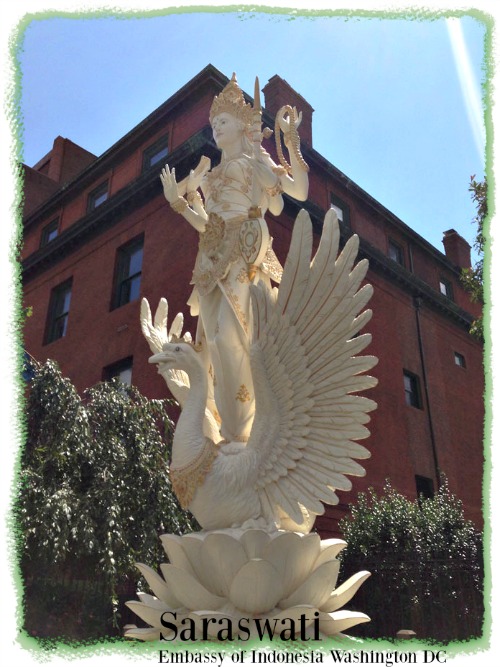
SARASVATI: The Flowing One Deanna McKinstry-Edwards #guestpost #July #MondayMotivation #Sarasvati #Saraswati #Saraswathi


SARASVATI: The Flowing One
by Deanna McKinstry-Edwards

In the bright world, where the light of the world opens, In the bright world, at the furthest border of The Word, Sarasvati poured out her rivering voices. Down, down, deeply down, the syllables flowed from the something that shines at the center of the world.            


            She came to me when the waters of my life were frozen.  I think I’d heard Her name many years ago, but nothing took hold, and perhaps I even heard Her call mine.  Some voices sound like the wind. Some like rain.  They rustle, they loosen, but its not yet their time to linger, so they pass through you, time and again, rustling, loosening your mind until you can hear and heed them in the language they speak. 

I had some exposure in my early days to stories of Goddesses, but I had not heard there was a Goddess who moved the world by a word, a syllable, a voice.  Fortunately, weather bristles in one’s psyche when the time is right for all manner of voices and words to be heard, to upend, to reconnect, to sing songs and retell stories long forgotten.  These stories work like magnets tugging at the personal story of each person’s life, wresting it from impoverished moorings too isolated from the epic and collective human story, and too fixed with nailed down notions to support the beneficent chaos which initiates birth and creativity.

            We were destined to meet, Sarasvati and I, since I have been, an actress, a singer, a writer, a devotee of breath churned into expression through melody and words.  For this is Her realm, the domain of sound, singing, eloquent speech, and intuitive wisdom. Originally a river goddess in the ancient Vedic texts, Sarasvati is the archetypal figure who embodies wisdom through the flowing motion of sound and running water.  Hers is the archetypal energy that compels us to break loose from inhibiting forces and stuck places, especially those rutted in our minds.  She compels each of us to loosen our notions and animate dialogues with ourselves, others, and all life, continually moving our minds like leaves riding a river.  It is not closure Sarasvati seeks, but open-ended conversation. 

            To meet Sarasvati, The Hindu Goddess of Speech, Sound, Music and Wisdom, is to meet the holy rivers veined through the inner and outer landscapes of our lives. “Sarasvati is the Word, and the Word is the way of The Gods.” (Calasso 239) writes Roberto Calasso in his lush and erotic book, Ka;  Stories of the Mind and Gods of India.  “The Word, and these waters, are the one help we have.  We shall follow the Word, so as to be able to leave it behind.” (Calasso 239)  Beyond the Word, it was written in the Vedas, was the center of the world.  A place  known as “Only something that shines.” (Calasso 239)

It was not the fate of all Hindu goddesses to remain important in later Hinduism.  But Sarasvati exemplified her own attributes of change and transcendence, by representing a  wisdom which permeates all life, that being to remain open to and flowing with life’s ever-changing nature.  Something primordial defines Sarasvati which extends beyond cultural associations to cosmic tendencies and attributes, and this feature of her archetypal zest is no doubt key to her continued survival and importance in Hindu culture even today.

David R. Kinsley,  author of Hindu Goddesses, describes Sarasvati’s earliest appearance as a river.  She is

“no ordinary river.  Early Vedic references make it clear that the Sarasvati River originates in heaven and flows down to earth.  Physical contact with her earthly manifestation, however, connects one with the awesome, heavenly, transcendent dimension of the goddess and of reality in general.” (Kinsley 57)


Even before Sarasvati The River and The Goddess flowed down from the celestial heavens, another Goddess, her ancestral progenitor, quickened and fertilized the visible and invisible aspects of the world through sound.  Her name was Vac.   The Goddess of voice.  Of word.  “Queen of a thousand syllables…” (Calasso 238), “Vac was a power at the world’s beginning.” (Calasso 238)  Wherever life grew parched,  and living things lost their luster, it was Vac who moistened and brighten them at their source.  With sound. Sarasvati emerged from the mythical husks of Vac, and though initially and consistently identified with her, over time Sarasvati came to represent characteristics other than those originally ascribed to Vac.

Although the distinction of sound and speech as primordial factors in the creation of the universe is a post-Rg-vedic concept, nevertheless sound, and speech especially when ritualized, are regarded in the Rg-veda as an integral aspect of cosmic creation and order.  Vac’s attributes exemplified the theory prevalent in many mythologies that the origin of the created universe occurred through sound.  In Hinduism, Vac besides being a primordial creative force, is also honored as

 “the presence that inspires the rsis.  She is truth, and she inspires truth by sustaining Soma, the personification of the exhilarating drink of vision and immortality.  She is the mysterious presence that enables one to hear, see, grasp, and then express in words the true nature of things.” (Kinsley 12)


Bear in mind, Vac was more than an abstract concept.  Her essential nature was that of an omnipresent, nourishing goddess, forceful as a lioness, decked in golden raiment, capable of fostering both fiercely and tenderly, organic growth as a result of providing the blessings of language and vision.  She is equated no less with the creation of Hinduism’s three Vedas, the earth (Rg-veda), the air, (Yajur-veda), and the sky (Sama-veda).  She is a Goddess at the very source of life, and Hinduism’s holy writ.  Gradually Vac’s vivid personification was assumed by and metamorphosed into Sarasvati.  Centuries later, additional qualities became attributed to Sarasvati which took on a primacy in the shaping of Hindu culture.

To understand Sarasvati’s transitions from earlier associations with Vac into her own Goddessdom, and from her earliest identification with the cleansing purity and fertility of the Sarasvati River, and rivers in general, one needs to consider the historical and cultural transitions occurring when nomadic life in India metamorphosed into agricultural, village societies.  Rivers were the life blood to these societies.  Understanding the nature of rivers was mandatory to survival.  Sarasvati’s river heritage affirmed a tendency in classical Hinduism to perceive the landscape itself as something sacred.  Rivers were considered symbolic places for planting, for healing, where one could cleanse one’s body and spirit.  Furthermore, not only were rivers places into which one could immerse one’s bodily self, metaphorically they assumed imagery indigenous to all three Indian religions, Hinduism, Jainism, and Buddhism—that being the fording of a body of water, be it river or stream for spiritual attainments.  By crossing over to the other side of a river, one drowned the deadening beliefs of the old self to be born afresh, to be liberated from the past, towards a new, more enlightened way of being in the world.

It is not known exactly, how The Goddess Sarasvati became less connected with her original river goddess status, and more associated with another Goddess, Vagdevi, the Goddess of Speech.  Kinsley speculates that,

“Perhaps the centrality of sacred speech in Vedic cult and the importance of Vedic rituals being performed on the banks of the Sarasvati River led to the identification of the two goddesses.  In any case, Sarasvati increasingly becomes a goddess associated with speech, learning, culture, and wisdom; most post-Vedic references to her do not even hint that at one time she was identified with a river.” (Kinsley 57)


I would suggest also that the transition Sarasvati traveled from ancient river status into the goddess of speech expresses an archetypal connection between a river’s ability to carry earthly sediments, and the voice’s ability to carry emotive sentiments. Intrinsically linked, voices and rivers move and shape inner and outer topographies.  Soul as soil, soil as soul.

Insofar as Sarasvati would eventually become a goddess equated with the refinements Hinduism attaches to culture and transcendence of the natural world, Sarasvati  could be said to have come full circle.  That is, as a Goddess of  learning and wisdom, such as it is attained through language, She has, in a sense,  returned to her celestial fount in the heavens, a domain above human travail.  But even though Sarasvati in present times is often represented as transcendent, purified knowledge and wisdom, riding a heavenly swan above the toil and turbulence of the natural world, she can also be Sarasvati seated on a lotus, rooted in the muck of earthly bogs.

Although rooted in the mud (like man rooted in the physical world), the lotus perfects itself in a blossom that has transcended the mud.  Sarasvati inspires people to live in such a way that they may transcend their physical limitations through the ongoing creation of culture. (Kinsley 62)


Sarasvati upholds a theme in Hinduism that affirms that human destiny is inextricably tied to notions of the refinement of nature.  Nature without these cultural refinements is not considered suitable for the fullest unfolding of a human being in Hindu thought.  These sentiments regarding the refinement of nature as essential to a human’s fullest potential possess a Western bias as well, and in so doing tend to emphasis and esteem certain human attributes at the expense of others.  With the more recent emphasis on purity and transcendence of the physical world, India’s present day Sarasvati appears more disembodied than her earlier incarnations.  But for all Her purified, sattvic nature, Sarasvati remains a Goddess of music as well as speech.  Music is untethered speech.  At her core, Sarasvati contains the fertile, rushing sap of Her beginnings; a juice squeezed from the Vedic philosophy of the primacy of syllables.  Jonathan Levi, in his review of Literature and The Gods, by Roberto Calasso,  in The Los Angeles Times, April 22, 2001, quoting from Calasso, writes, “One squeezes juice, from anything, but not from the syllable:  Because the syllable is itself the juice of everything…And from the syllable all else flows.”

Sarasvati is a particularly juicy goddess for modern times, especially perhaps, for modern day women.  She is not a goddess of motherhood, or the fertility of the fields, except metaphorically.  What She gives birth to are creations other than human progeny.  Hers is not a domestic presence in the traditional sense of keeping house, but of housekeeping by creating eloquence, art, wisdom through artistic discovery, poetry and music. With words She tills the fields of  human longing and  imagination.  She is the running dialogue at the center of  human affairs, spinning the stories within which we nourish our lives.  “The world is made up of stories, not atoms”, wrote poet Muriel Rukeyser.  The sounding harp of the Universe is plucked by Sarasvati, and key to understanding her wisdom, is hearing and releasing the sounds She makes, allowing them their ever flowing, ever-changing-ness.

In my own life, Sarasvati’s presence has been especially potent and integral these past few years.  A story about Her swayed my decision as to where and how I should continue my education following a return to school to complete a bachelor’s degree begun over thirty years ago.  Drawn to Pacifica Graduate Institute, torn between a degree in Psychology, which I perceived as possessing definite financial largesse somewhere up ahead, and The Mythological Program which seemed possessed with as sure-footed a financial future as the acting profession, I cast my net for a sign, an omen.  I got a story.

Once upon a time in a faraway land, a man went into the forest to see his spiritual master.  “I want to have unlimited wealth, and with that wealth, I want to help and heal the world.  Will you tell me how to create this affluence?

The spiritual master replied.  “There are two goddesses which reside in the heart of every human being.  Everybody loves these two goddesses, but there’s a secret you need to know, and I will tell you what it is.”

Although you love both of these goddesses, you must pay more attention to one of them.  She is the Goddess of Knowledge, of speech, music and sound, and her name is Sarasvati.  Pursue her, love her and give her your attention.  For when you pay more attention to Sarasvati, the other goddess, Lahksmi, the Goddess of Wealth, will become extremely jealous and pay more attention to you.  The more you seek Sarasvati, the more the Goddess of Wealth will seek you.  And she will follow you wherever you go, and never leave you.

In that mysterious way our Psyche senses even seizes what it really wants…and, in the gap between that psychic sensing and fearful admonitions of the ego, responses glimmer.  Of course, I already knew which program it was I wanted.  The Myth Program.  The one with the knowledge that really called to me.  It was just a question of how much faith and derring-do I still retained. It was just a question of letting a story reconnect me back to the source of something shining.

Certainly a most shining manifestation of Sarasvati in Buddhism was a woman who became the first Tibetan to attain complete enlightenment.  Her name was Yeshe Tsogyal, and her life story is written about in a book, Lady of the Lotus Born.  She is often referred to as The Great Bliss Queen.

For Padmasambhava, the guru who brought Buddha’s teaching from India to Tibet, to propagate his teaching of the Secret Mantra, he felt the time had come for an incarnation of Sarasvati to appear.  Yeshe, whose birth reverberated a Sanskrit mantra through the air so powerfully that a nearby lake increased to almost twice its size, was the wife of Emperor King, Tri-song-dat-tsen of Tibet.  It was Tri-song who invited Padmashambhava to Tibet to spread the new tradition of Buddhism.  With his consent, Yeshe became Padmasambhava’s consort and foremost disciple. She was the embodiment of the Sarasvati he was looking for.

Yeshe and Padmasambhava through sexual union, mantras and chanting dissolved artificial boundaries between the mind and the body.  Rather than forsaking and attempting to transcend the body, the Tantric wisdom that Padmasambhava advocated engaged both body and mind for enlightenment.  Creating a bridge of sound between mind and body composed of sounds and sacred syllables facilitates an enlightening, informing dialogue between them.  Keeping this river of sound flowing and being aware of its ever-changing, interdependent behavior is the heart of Buddhist wisdom. Buddhism’s most reknown Sarasvati, Yeshe Tsogyal, learned how to make her body sing, and became both the singer of her life’s song, and the song itself. 

 Sarasvati, such as She manifested in the bodhisattva archetype of Yeshe Tsogyal, presents an embodied Goddess who has married within herself the heavier, darker emotional sounds of soul as they move through the human body, and the flute-like soaring sounds of spirit, such as they leap from the human mind. This Sarasvati appeals to me immensely, for no parts of Her appear to be in exile.

Today, with so much talk about creating a sense of community in our lives and world, saturated as they are with feelings of alienation, I feel Sarasvati’s presence holds a promise. As the Goddess of speech and music, She carries the virtues of connection and communication. Robert Sardello writes in his book, Facing the World With Soul,. “When community does show forth among people it shows in the word, the living, creative, unexpected, heartfelt, spontaneous, thoughtful, reflective speaking through which the soul of the world finds voice.” (Sardello 181).  This is Sarasvati’s Queendom, the shining place where words wait to be born in the mouths of living things. Voice is how the soul speaks

In speaking the breath connects us to each other.  When we bank and shape this breath with the consonants and vowels of whatever language we speak, we become like the earth, banking the forces of a river so it can meander with some depth through the landscape moistening and moving it with life’s running waters.  It is a sacred thing we do with breath and speech that Sarasvati oversees.  It came to me so vividly just a few nights ago, as a small tree rat lay dying in the street by my driveway.  I knew not what had happened to it.  Poison, I assumed.  But suddenly I was profoundly overcome.  I could not leave him (her). Her tiny eyes seemed to take me in, as I took her into me.  We were inhaling one another.  We were a community of two, two souls speaking of the deepest things between us.  I asked Sarasvati to hold her in Her breath as I lay her small furry body on soft ground under some vines, to expire. I knew She would say the right words.  And that the little tree rat would hear her name in Her merciful voice, and be released into Her flowing music as she headed home to the bright world from whence She and she, and all of us came…together.

Wednesday, June 21, 2017

A BONE BROTH FOR SOUL-MAKING #NationalSelfieDay


WILD HUNTS and The Secret Instinct

In the full light of a theology of sin, the false self appears as not just logically incoherent  but morally dreadful…When the duplicitous subject turns away from god in his duplicity he mocks and parodies god’s own good activity. –Blaise Pascal


see
it’s not that it’s a witch hunt
it’s that it’s a wild hunt

a furious host
the white house
in something

morally
dreadful
disembodied dees

secrecy falsifies—
simulacra is
no photo

no video
press briefings 
logically incoherent

the house
man
eye

white with duplicity, "his
imaginary" press briefings
try to make “good”

knot this start again
it’s not “make great again”
it’s make “good” good again

stay with the wor(l)d you face
as it tries to make something
good grow down in your bones

empty your will—not “empty vessel”
the face of her wild long river
is working into broth underneath you 

D-meter vagina dentata eyes of blood
and wings of angels rage after the
white-housed man with the

falsifying eye
driving under
the influence

inside, the furious host
in the white housed
secrete dees

worms fall out
to make our
story come clean

deny
delay
deflect

deceive
the outside
furious hunt

seeking soiled linens
duplicitous parodies
gods borscht boys &

goodfellas; outsides pair and
dye dees showing in phainein form
the false nature of being creative

duplicitous gods
brown this June
with Demeter’s refusal

disembodied is our spirit
times, even the wild hunt is claim
to the disembodied in lives now loosed

upon the soul. But, the maiden underneath
makes “good”  materialize
apart from the materializing of things

so give yourself to this other kenotic life
and let it shape the talisman, an
immediate access to profound wisdom


broth in our bones


©2017  Wild Hunts & The Secret Instinct stephanie pope mythopoetry.com

_____________
notes

see  Blaise Pascal, On Duplicity, Sin and The Fall: The Secret Instinctp. 120


Monday, June 19, 2017

A REPRESENTATIONAL SELF


A MAD DESIRE FOR A JUST WORD

Click on this image. Watch
the cat disappear— all but his smile!


Cat up a tree

gone into canopy
smiling angel
creative emotion  
insighting power
under the pen—me
ow me-oozing, smiles
throwing words into
their true order but

never trust a smiling cat[i]
grin hanging in a tree

©2017  A Mad Desire For A Just Word  In A Representational Self
stephanie pope mythopoetry.com  #GarfieldDay

___________

notes


 additional quotes:

1.  “But, I don’t want to go among mad people.” – Alice   ("Alice in Wonderland”, Lewis Carroll)

2. “Soul, aware of the dreadful nature within situation’s reason and reasoning’s intelligences, understands there is no use trying to account for the grinning existences hiding in words.”

 
 see  Be(e)Speak! The Deformational Image by Stephanie Pope


[i] Famous Garfield quote

Saturday, May 6, 2017

WHEN THE FIFTH IS WITH US #mythopoetry #slapdashsat #ThingsJesusNeverSaid #amwriting

May The Fifth Be With You


WHEN THE FIFTH IS WITH US

      "May The Fifth Be With You," my friends on facebook repeatedly exclaimed yesterday.  Well last night the spirit of the fifth was with me!

Last night, Cinco De Mayo, May the 5th was filled with a night of dreaming.  I decided earlier in the day a “staycation” was in order, a staycation of another sort.  My sweetie and I stayed home and created our own celebration which included a fifth of another sort as well—tequila instead of whiskey (naturally!)

I made beef chimichunga, pico de gallo, mango salsa, refried black beans all from scratch, got out the Mexican placemats, tabletop sombreros, Our Lady of Guadeloupe candle stick and a set of authentic maracas.  Then my sweetie and I got the bright idea to share our fare with the BFF couple who live across the street.  Gathering up a share of the feast and a pitcher of my sweetie’s marvelous margaritas we had one of those unplanned perfect evenings.

This morning I awakened from a dream.  In it I was roller skating through Texas.

The dream me was tired and looking for her hotel among the many shops and restaurants about her.  She stopped into a neat restaurant to ask directions.  They didn’t turn her away but they did have a strict dress code and wanted to seat her in the fast food, casual dining area as opposed to the fine dining section.  This is when she looked down towards her wheeled feet and noticed she was missing the right pant leg of her jeans.  She also realized the folks at the restaurant misinterpreted why she walked through the door! 

Here’s where I awakened feeling the mood of things.

I tried to work with this dream today without success until I got the bright idea to work not from my own image associations for the dream but hers.  Let me call her Texas Roller Girl.  This means she is now a personified notion.

Texas Roller Girl has a missing right pant leg.  She could never keep her pant legs rolled, she can only keep the left pant leg rolled.  She has a mortal side, her left side and an immortal side, her right side, the one already missing its fabric.  Yet, Texas Roller Girl stays rolled or “rolling” by the nature of her soles, a polutropic dream pun, perhaps, for “soul” and maybe too, an image gerund-ing to presence “a wing-ing” movement in the dream figures that moves us, first, beyond our own perceptions of things to its perception of things and then through it again, moving (us) from object (the itness or psychic realness) to fabric or to fabricating (that gerund-ing notion again) what may be working the next room of the dream.  The fabric is the image telling its own story we experience as a dream. What seems like a strange fabrication makes no sense at first until seen through the eyes of the pilgrim roller girl passing through it.

Now, let me turn to “the working in”, “the next room of the dream.”

Long before supper time yesterday I had just read about the ancient Greek sculptor Lysippus and his ideas regarding a certain figure in the Greek pantheon, Hercules Epitrapezius, Hercules of the Table.  For Lysippus, he is the guest who may knock at your door anytime, that guest for whom you must always reserve a seat at the table.
The sculptor goes so far as to say, “to this guest goes the seat at the head of your table.”

This is a figure that begs hospitality.  Moreover, this figure’s herculean effort over sees and rebalances the boundary between interiority’s and exteriority’s too rigid divide.  The outsider and the outed sides are suddenly showing up as part of a dream figures context. Under this theme of guest, host and pilgrim, interior figures and exterior figures can speak their peace freely to each other, be welcomed and be listened to, exteriors and interiors performing together  i.e. gerund-ing to presence like a pair of wings on a lyre, that is soles no longer soles are signaling a winged instrument at work, an ensoulment. 

Ensouled with wings, the spirit of the fifth reminds me of one of the epithets for Hermes, homogenie.  This is the idea in the word homogenized. Coming and going, Hermes Homogenie unites inside and outside and this is like a pair of wings on a lyre playing together. When the fifth is with us soul claps its hands and there is singing school.
 

©2017 When The Fifth Is With Us stephaniepope mythopoetry.com


Thursday, May 4, 2017

GUEST POST BETH ANNE BOARDMAN, PH.D : THE SPIRIT OF ACTION #MayTheFourthBeWithYou


THE SPIRIT OF ACTION


              If one could bottle the elixir of motivation, one might make millions.  What moves someone from stillness to action? 

 - Dr Beth Anne Boardman
    
cultural mythologist


THE SPIRIT OF ACTION


If one could bottle the elixir of motivation, one might make millions.  What moves someone from stillness to action?  How does one overcome complacency or emotional paralysis and take healthy, constructive, creative action?

Motivation fades and surges according to its own inconstant logic.  How wonderful would it be, as one slumps at one’s desk, preparing to prepare one’s yearly taxes, to be able to chug down a quick shot of elixir-of-motivation, and get the job done?  How fabulous to conquer stage-fright and let one’s passion fly with an effortless sleight of hand, or get that dissertation done by just opening the laptop.  One hears the phrase liquid courage, but the spirit of action is more mercurial, more insubstantial than Jack Daniels. 

Mercurial: difficult if not impossible to pin down, grasp, define.  Uncontainable.  Not always apparent.  Unpredictable.  Written in the wind.  Words point in the direction of mercurial; images, though, evoke more complex meanings and help illustrate the enigmatic.  Ancient cultures around the world drew or painted or carved the likenesses of winged humans, angels, gods, fairies, and mythic beings who moved between the worlds—between heaven, earth, and the underworld.  Wings signify the unseen power of the air, the mysterious aspects of communication (prayer, intuition, meditation) between humans and what they perceive as invisible, divine energies outside of themselves. 

In addition to angels, gods, goddesses, and other mythic beings, people also honor and pray to saints, prophets, stars, the spirits of the Ancestors, and/or the planet’s natural elements.  Celtic tradition collectively names these unseen energies the Otherworld.  Fantastical images and stories of otherworldly beings emphasize that Divine Power(s) exist outside of the human world and thus remain unpredictable and inscrutable to humanity.  Jungian and Archetypal psychologies suggest that each individual’s mind and imagination can reflect these otherworldly energies, with the caveat that one may contain aspects of the divine but cannot possess all the power of the divine.  In other words, we recognize Love in ourselves, but we do not command the power of Venus or Aphrodite.  One may embody qualities of a Warrior or Defender, but one cannot bend the energies of Mars or Aries to one’s personal human will.

Diverse sacred traditions admonish humans not to gaze directly upon the gods.  The gods/the angels/the spirits – all shy away from explicit contact, and their reticence must be honored.  When the Biblical Moses encountered I Am that I Am on the mountainside, he saw only a burning bush, and through this interaction, understood that the human form cannot contain or withstand the actual power of God.  In the Greek myth of Semele’s contact with Zeus, her pleas to see him directly resulted in the spontaneous immolation of her human form.  These stories and others like them reinforce the reality of human frailty, our divinely ordained imperfection.


Early Greeks and Romans told of Hermes (Greek) or Mercury (Roman), gods who traversed between the worlds, passing messages between


gods and humans and accompanying beings that needed to travel to and fro between heaven, earth, and the underworld.  Represented by wings on his cap or the heels of his boots (or both), Mercury’s essential responsibility and quality, therefore, is to come and go; and since he is a god, his movements are beyond feeble humanity’s ability to predict or command.  Mercury gives a face to the unseen spirit of action, illustrates the ephemeral power of motivation. Alchemists, the philosopher-scientists of old, called this spirit Mercurius, the force they recognized as the power behind both worldly and spiritual transformation.

This is the mystery of motivation: human will-power can achieve much, but only inspiration, the visitation of the mercurial spirit of action, can lead us to accomplishments beyond our planning.  Mercurius provides us moments of its otherworldly power to transform ideas into actions, dreams into realizations. Like any of the other gods, the Spirit of Action will not be summoned, only invited.  And when invited, it may or may not coalesce.  A humble stance honors that the great energies of the universe defy human containment.  Creative, purposeful action requires a sensitive dance between power and receptivity on this spider’s web of life. 

In paying attention to the quiet whisper of our inner guidance and gathering up our human willingness, we take the first step on a new journey.  Along the way, we honor the otherworld and welcome the mercurial power of action to suffuse us with inspiration.  Honor the gods, the old stories say, and remember to give thanks for those times when we find ourselves wonderfully mid-action, not knowing quite how we got there, and amazed at finding done what we thought we couldn’t do. 


ABOUT THE AUTHOR


Beth Anne Boardman, RN, MA, PhD lives in California and New Hampshire. She travels and lectures on the Mythology of Sport; Women and Myth; and the Alchemy of Adolescence (her dissertation topic), in addition to consulting as a writer to websites.  

Recently, Beth has served on the board of the Pacifica Graduate Institute Alumni Association and as Regional Coordinator for local alumni. Her career spans work as a registered nurse, the study of world dance and music, and the profound joy of raising two children. 

BLOG


For stories and essays on creative life and culture visit Dr. Beth Ann Boardman at MYTHMUSE

POETRY BLOG


POEMS FROM THE OTHERWORLD


Friday, April 14, 2017

APRIL HIDDEN BUT EMPTY #EASTER #GOODFRIDAY #PASSIONWEEK #NATIONALPOETRYMONTH 2017


NEST   stephanie pope


A lady quail came before Passion Week
this year & laid 10 eggs in the patio
flower pot resting just underneath my
bedroom window. But last night I lay
at rest and dreamed an emptied nest.

In the morning how not removable
is thy lost word nesting where I lay
so stunned & moved by inner losses
throughout my own night’s sleep. Yet a way
of knowing moves in & is laid to nest here

with me. Something else
having pierced my breast
gotten under my skin diminishes
the low point and then moves on. 
My rest and my restless rest

sweetly worded wordless shape thy bird
what shaped in loss returns. In pale voice
a laid-to-nest begins in wing to seek
thy nearly touching hand: the empty nest
in likeness renders goneness small―_ _all

not read and empty yolks me
―I cradle your big history resting in
my emptied nap poetizing growth. How
touching,
centerless 
nourishing
divine
no thing is in thy yellowing moment.

I forgot to say how the father quail
sits a good long while on those speckled eggs
during the day.  In heat, no word, these words are
so like thy yellow hand fashioning what a shape
in loss returns by thy nourishing masculine form.
 
A bird plays the big green role— my days, cracking
ten whole eggs darkly hidden in his feathers. 
Night, too, is dream-shaping my nest & with subtlety
suggests a bright lady yolks in my unrest, her goneness
reappearing as light

& days in the kitchen have blazed.


©2017 Nest stephaniepope mythopoetry.com

visit @mythopoetry


Thursday, April 6, 2017

#NAPOMO 2017 #GUEST #POETRY #BLOG "reopening" by BETH ANNE BOARDMAN for #NATIONALPOETRYMONTH


reopening


i found an old poem –

written on a warm day,

when a dramatic offshore wind
streamed spray out to sea,
off the crests of rolling, tumbling
massive turquoise waves….

“here’s the truth:”
the poem said. 
“I no longer believe
in true love….”

oh! sad! (i thought.)
(how long ago did i write this? why?)

“I no longer believe in love
between a man and a woman,”
the poem went on.

(hm, what?)

“I believe in
  silence
  and space
  and the
  great unknown.”

(ah!)

“I have gone into
 the place
 I have always feared.”

(yes!)

“Beyond ideas of
 love –
 and into
 silence.”

(oh, yes!)

silence:
a cold, interstellar
kind of place, at first –

terrifying

huge

endless –

like standing in
the mouth of a huge black cave….

yogis, holy people, healers
tell us:

in silence lives all possibility.

all dreams
hopes,

nightmares
next to despair –

we humans will
hop like jack-rabbits,
dance like deer
(i’m afraid i’ve done these things myself)
just to outrun  

silence....

ubique silentium….


here’s the thing, though:
silence contains the grail –

truth, love – tristan and iseult, arthur, the green knight –

it’s hard to describe, but
listen….

in welcoming my own existence,
in making a hospitable place for my dreams,

i am finding a dearness in myself –
what a surprise! 

and all my loves have deepened,
and breathing comes ever easier,

and guess who just walked in my door?
True Love!

©2017 mythopoetry.com
©2017 Beth Anne Boardman All Rights Reserved


ABOUT THE AUTHOR


Beth Anne Boardman, RN, MA, PhD lives in California and New Hampshire. She travels and lectures on the Mythology of Sport; Women and Myth; and the Alchemy of Adolescence (her dissertation topic), in addition to consulting as a writer to websites. 

Recently, Beth has served on the board of the Pacifica Graduate Institute Alumni Association and as Regional Coordinator for local alumni. Her career spans work as a registered nurse, the study of world dance and music, and the profound joy of raising two children.


For more poetry by Beth see
 
 POEMS FROM THE OTHERWORLD


For stories and essays on creative life & culture see   MYTHMUSE

Friday, March 31, 2017

GUEST BLOG...POETRY! "Two Forms Of Life" by Dennis Patrick Slattery


TWO FORMS OF LIFE
Awe is the salve that will heal your eyes. Rumi


A man with a gray face woke

With a keen thirst wanting after desire.

Stillness is so far on the other side of

The dream he floated in last night.


An old man with a white face

Fell one morning into a

Critical morass.

Now his terrain offers few options.

No matter—within the slide show

Of a shallow life

He complains it is someone’s fault

But his words fall around him.  


©2017 Two Forms Of Life
Dennis Patrick Slattery

©2017 http://www.dennispslattery.com/
All Rights Reserved


COME VISIT DENNIS AT
http://www.dennispslattery.com/ 


Thursday, March 30, 2017

GUEST BLOG...POETRY! "Deep Enough" by Dennis Patrick Slattery


DEEP ENOUGH

These words-their aspect was obscure--I read/ inscribed above a gateway, and I said:“Master, their meaning is difficult for me.”   Inferno III. 


Is my reading deep enough?

Can I attend to the pilgrim’s

sinister descent where stench

assaults the eyes and the shades

crisp in scabbed skin

rend the ears into scratched awakenings?


What form might Virgil,

virgin of the underworld assume

his dark shape and clothed

poetic pose wrapping arms

around his naïve charge

pushes him along

through loiter-free zones

echoing moans of remorse.


The naked truth groans in a chorus

of demented laments.

No birds fly through sticky air.

Mistakes in life cling with miniature

fury to everlasting nows

pock marks in eternity.


A river to their left courses

hot bubbles of blood;

shades breach to the surface

chunks of meat in a stew that

knows its own end:

Consistent

Insistent

Resistant


©2017 Deep Enough Dennis Patrick Slattery
©2017
http://www.dennispslattery.com/
 All Rights Reserved


VISIT DENNIS AT http://www.dennispslattery.com/ 

Thursday, March 16, 2017

GUEST BLOG... POETRY! "Completion" by Dennis Patrick Slattery


COMPLETION
    Depth started to throb -Jori Graham


The painting sits upright

                  against the file cabinet

          almost completed; it can’t

find the place of finish, a space

                   where things are allowed to end.

          No studio for it to be done

signed and touched no more

with thoughts of brush.


It needs a tiny woman

                  walking away from the viewer

          with her tiny black dog no larger

than a leaf/just a stain of black

                   will bring it to life.

          But no proper space avails

to allow it a final shape

a completion.


The smaller trees in back

                   then larger and still larger

          masses of green, mottled trunks in front

stand alone beside one another;

                   they smell the loneliness.

         Cezanne can’t find his own footing

his easel or canvas stand.

                  The asphalt path ribbed

          with shadows of trees we cannot see

 because the woman and her dog

                   have long passed

         yet remain unpainted.


They want to be there, content to stroll

           as they do in the photograph I paint from.

          Some license, surely, but not them

they are not incidental to the life of trees.


I want to see them—after they are painted in

        two figures to ease the gap of loss in depth.

          When the painting is framed and hung

on the living room wall, I want to see

                   them enjoying the trees

          I painted for their delight as they stroll

by and through the lushness of green.


I will wave to their tiny shapes

                   meandering on the path, their

          backs to me getting smaller

her dog sniffing a red wildflower

unaware I am behind them

                  happily waving at their beauty.

         They continue to diminish

                  as do I to them  

in my blue shirt, like hers

 now almost the same size.
 

©2017 Completion Dennis Patrick Slattery

http://www.dennispslattery.com/
All Rights Reserved